The Story of the Great Flood of 1951
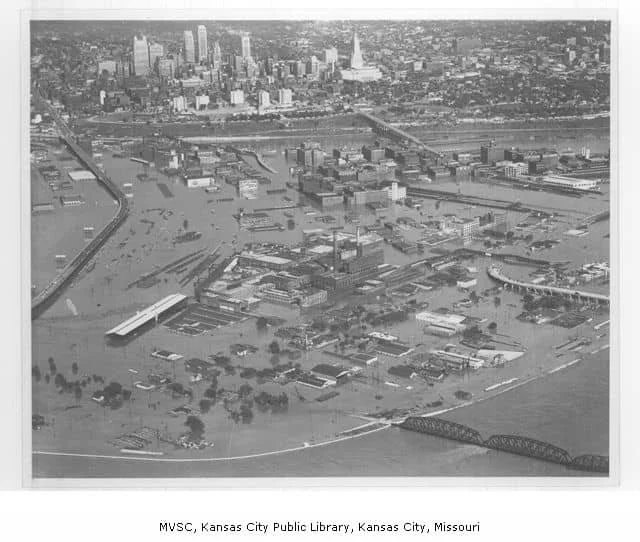
Courtesy: Missouri Valley Special Collections, Kansas City Public Library, Kansas City, MO
In mid-July 1951, Kansas City and its surrounding regions experienced one of the most devastating floods in their history, triggered by heavy rainfall that significantly raised water levels in the Kansas, Missouri, and other nearby rivers.
This catastrophic event affected vast areas across Kansas and Missouri, causing extensive damage and loss of life.
The Onset of the Flood
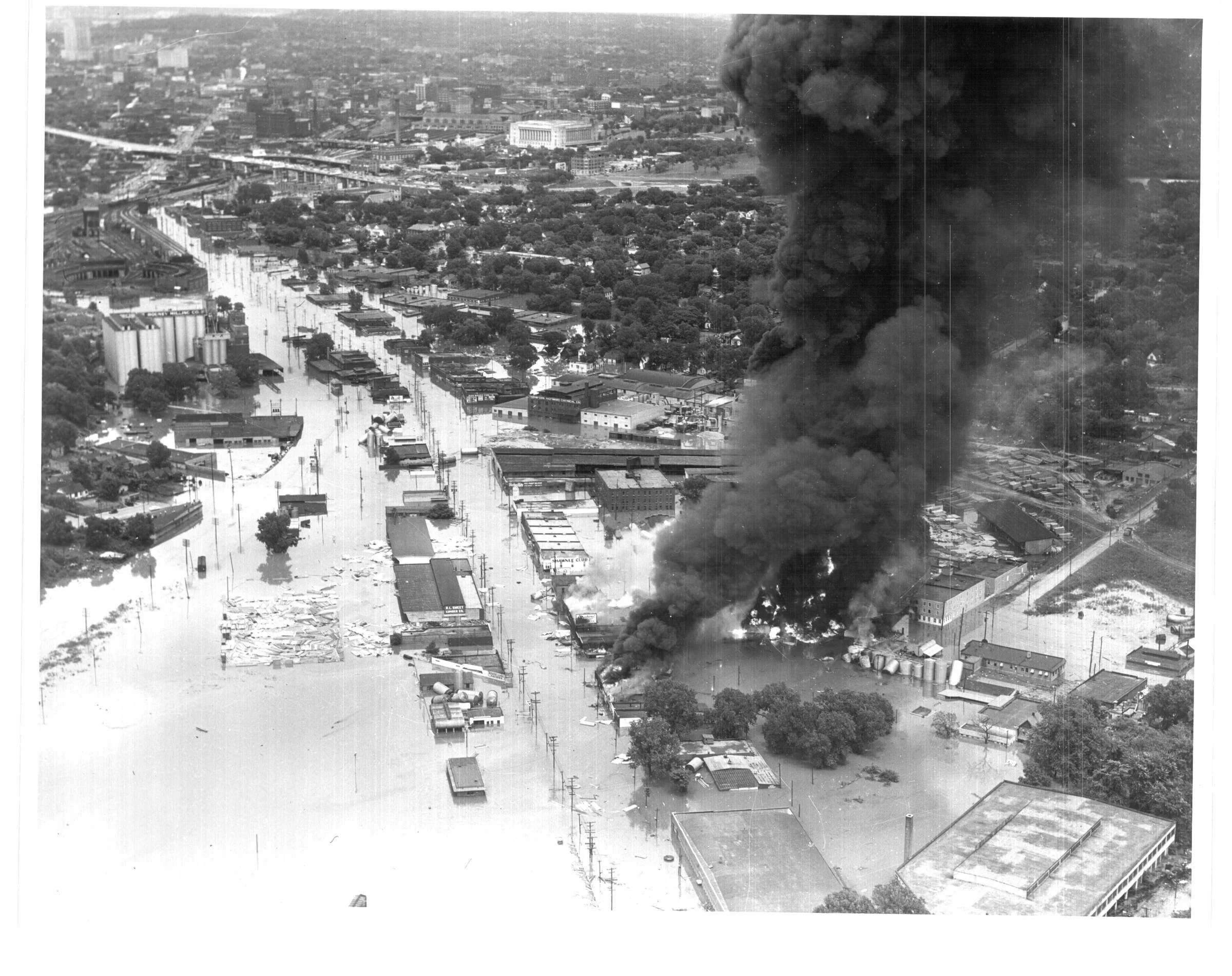
Aerial view looking east along Southwest Boulevard at 31st Street. Shows Phillips Petroleum tanks on fire. Upper center shows Union Station and the Pershing Road Post Office. Courtesy: Missouri Valley Special Collections, Kansas City Public Library, Kansas City, MO
The flooding began in May 1951, with Big Creek in Hays, Kansas, experiencing significant overflow. This initial flooding set the stage for what was to come, as heavy rains continued into June and early July.
By mid-July, the region had received between 8 and 16 inches of rain over a few days, culminating in unprecedented flood levels that surpassed previous records set in the Great Floods of 1844 and 1903.
Impact on Kansas City
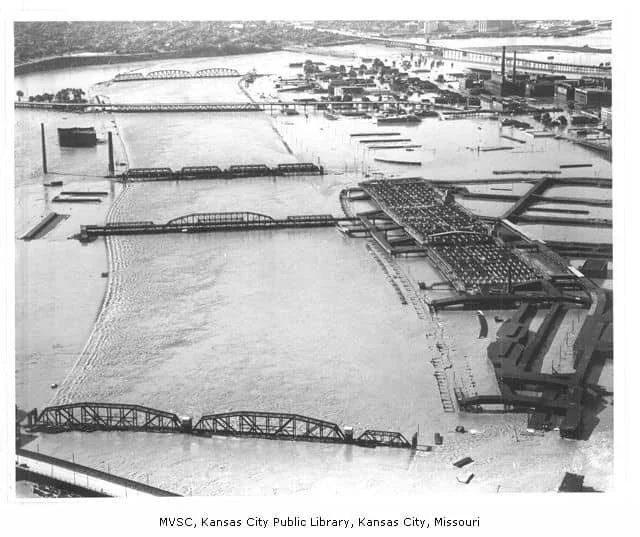
Aerial view of flooded area, looking north of bridges spanning Kansas River and the stockyards. Courtesy: Missouri Valley Special Collections, Kansas City Public Library, Kansas City, MO
On July 13, the Kansas River crested, causing the levees in Kansas City to overflow. The Argentine and Armourdale areas were severely affected, resulting in the evacuation of 15,000 residents.
The floodwaters reached the rooftops of homes in Armourdale and submerged the Kansas City Stockyards in the West Bottoms, a major economic hub at the confluence of the Kansas and Missouri Rivers. This devastation marked a turning point for the Stockyards, which never fully recovered their pre-flood prominence.
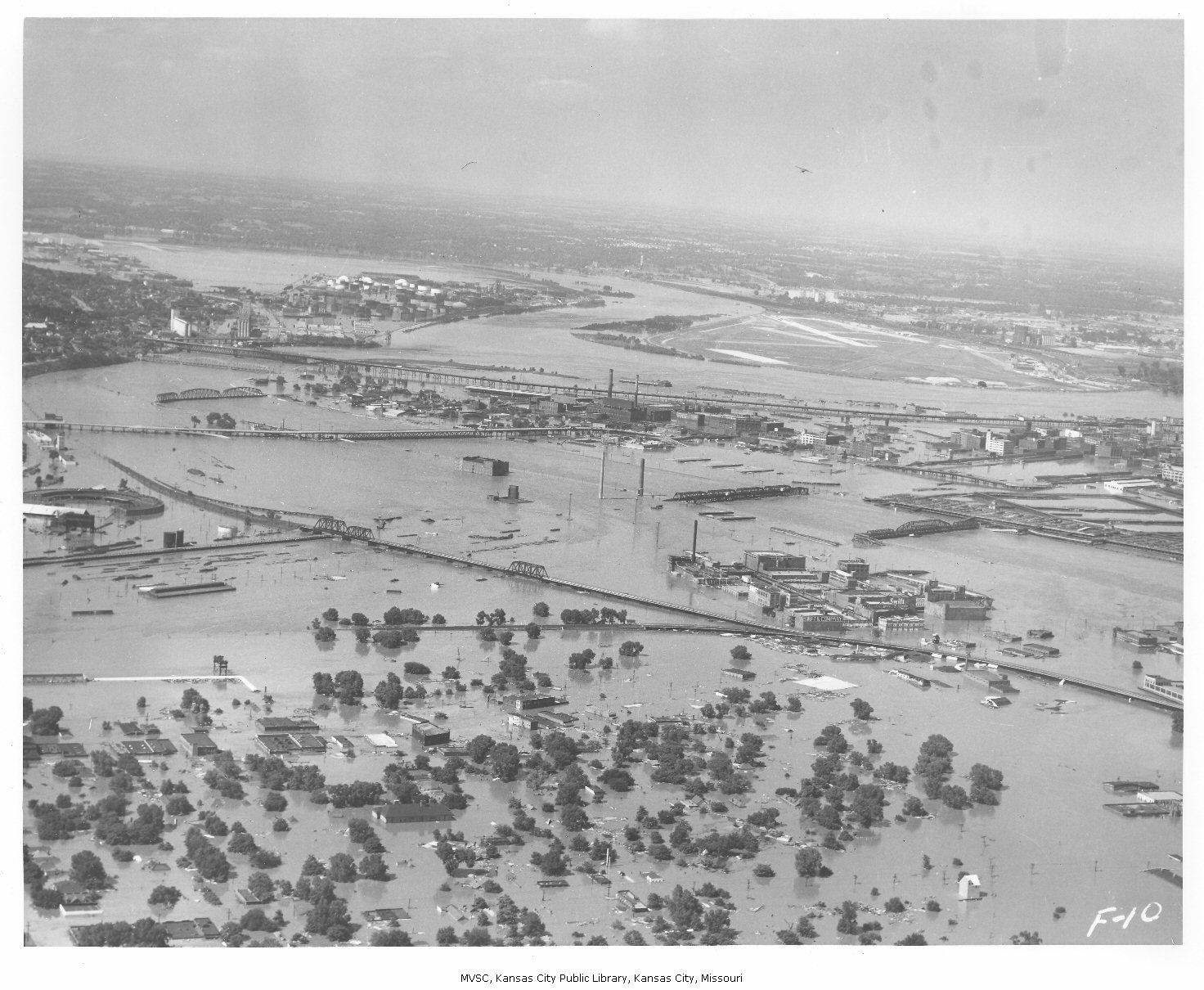
Aerial view of the confluence of the Kansas and Missouri Rivers in the aftermath of the 1951 Flood; shows Municipal Airport (upper right) and Swift packing facilities. Courtesy: Missouri Valley Special Collections, Kansas City Public Library, Kansas City, MO
Businesses throughout the West Bottoms suffered immense losses. The flood destroyed the TWA overhaul base at Fairfax Airport, a critical facility for the airline industry.
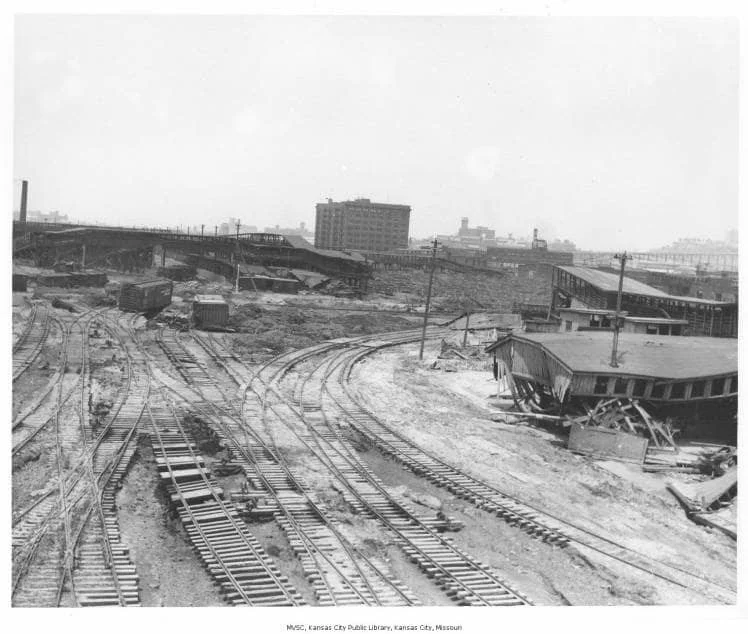
This destruction prompted the city to eventually relocate TWA's operations to a new airport in Platte County, which later became Kansas City International Airport. The flood also severely disrupted rail and road transportation, with many routes rendered impassable.
Residential areas were not spared, with entire neighborhoods submerged. Homes and businesses in low-lying areas were particularly hard hit, with water levels reaching the rooftops in some cases. The damage extended beyond physical destruction, affecting the livelihoods of countless families and small businesses.
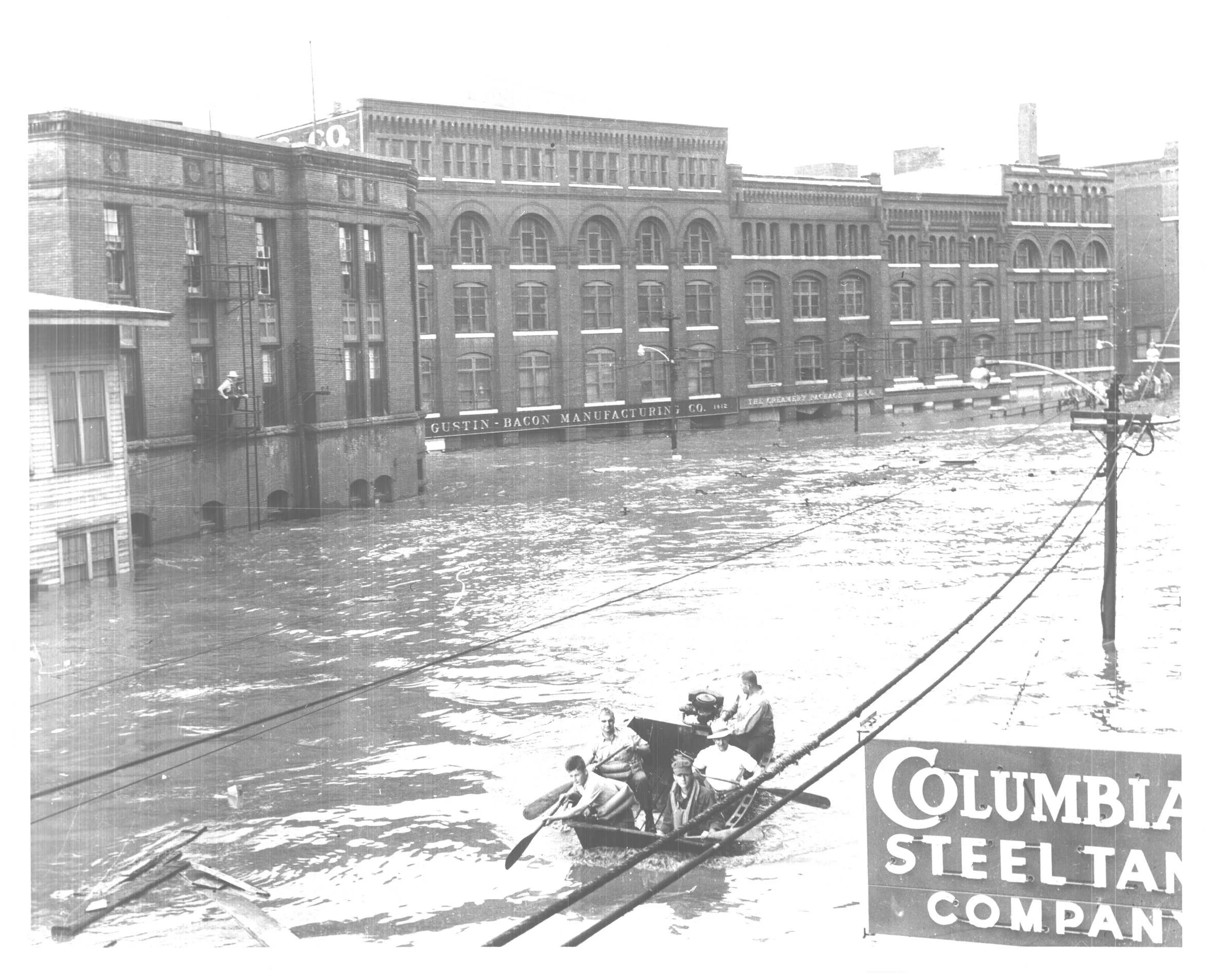
View of unidentified men in flatboat near the foot of the 12th Street Viaduct at 12th and Liberty. Courtesy: Missouri Valley Special Collections, Kansas City Public Library, Kansas City, MO
The broader metropolitan area also saw widespread evacuations and emergency responses. Schools, hospitals, and other critical services were strained, as communities struggled to cope with the immediate aftermath.
Emergency shelters were set up to accommodate displaced residents, and the local government coordinated with federal agencies to manage relief efforts.
Extent of the Damage
The 1951 floodwaters inundated 1,074,000 acres in Kansas and 926,000 acres in Missouri, affecting numerous cities and towns. Major urban areas like Manhattan, Topeka, and Lawrence were extensively damaged, with thousands of buildings destroyed and tens of thousands of residents displaced.
In Kansas City, the flood caused severe disruptions, with 28 lives lost and nearly $1 billion in damages (equivalent to approximately $10 billion today).
In response to the disaster, President Harry Truman declared the flood one of the worst in U.S. history. This led to the construction of a series of levees and reservoirs across eastern Kansas, aimed at preventing such widespread destruction in the future.
These flood control measures proved effective during subsequent flooding events, including the Great Flood of 1993, which saw significantly reduced impacts due to these improvements.
Courtesy: Missouri Valley Special Collections, Kansas City Public Library, Kansas City, MO